



Executive Summary
Artificial Intelligence is rapidly changing how organizations operate, compete, and create value.
Across industries, executives are investing heavily in AI platforms, copilots, automation initiatives, and intelligent decision-support systems. Yet many organizations are discovering that technology alone is insufficient to deliver sustainable business outcomes.
The greatest barrier to AI adoption is no longer technology—it is organizational readiness.
The challenge is no longer simply deploying AI.
The challenge is preparing people, processes, operating models, data, and governance frameworks to work effectively alongside intelligent systems.
Organizations that realize meaningful business value from AI will not necessarily be those with the most advanced technology. They will be the organizations that develop AI-literate workforces, establish AI-ready operating models, and build trusted data foundations capable of supporting intelligent decision-making at scale.
AI Literacy will become one of the defining competitive advantages of the next decade.
As AI capabilities continue to evolve, every employee—not just technologists—will require a foundational understanding of how AI works, where it creates value, what risks it introduces, and how to collaborate effectively with intelligent systems. AI literacy is rapidly becoming a business capability rather than a technical skill.
Organizations that successfully scale AI will combine technology investments with workforce readiness, responsible governance, trusted data foundations, and operating models designed to integrate intelligent systems into everyday decision-making and business processes.
This paper explores why AI literacy matters, the capabilities organizations must develop to become AI-ready, the role of trusted data and governance, and how enterprises can create cultures that enable responsible innovation and sustainable competitive advantage.
The organizations that invest in AI literacy today will be better positioned to transform AI from a collection of tools into a lasting source of business value and, ultimately, a defining source of competitive advantage.
The AI Adoption Paradox
The pace of AI innovation continues to accelerate.
Large language models, generative AI, copilots, autonomous agents, and intelligent automation platforms are rapidly entering the enterprise. Organizations are investing billions of dollars in AI initiatives with the expectation of increasing productivity, reducing costs, improving customer experiences, and enabling entirely new business models.
Yet despite the unprecedented pace of innovation, many organizations continue to struggle to translate AI investments into measurable business outcomes.
Pilot programs fail to scale. Adoption remains inconsistent. Employees question AI-generated outputs. Governance concerns delay deployment. Business leaders increasingly ask whether the anticipated value from AI is actually being realized.
The problem is rarely the technology itself.
The problem is organizational readiness.
Most organizations have focused on acquiring AI capabilities before developing the organizational capabilities required to use them effectively.
This is the AI Adoption Paradox.
Organizations are becoming AI-enabled faster than they are becoming AI-literate.
Technology is advancing faster than organizations are evolving.
As a result, many enterprises find themselves caught between aspiration and execution. They possess powerful AI technologies, yet continue to operate using processes, governance structures, and operating models designed for a pre-AI world.
Technology alone does not create transformation.
People create transformation through technology.
And people require more than tools. They require new skills, new ways of working, trusted data, effective governance, and operating models capable of integrating intelligent systems into everyday decision-making.
This is where AI Literacy and AI-ready operating models intersect.
AI Literacy prepares individuals to work effectively alongside intelligent systems.
AI-ready operating models prepare organizations to realize value from those systems.
Together, they bridge the gap between technological capability and business transformation.
Organizations that successfully navigate this transition will gain more than productivity improvements. They will establish new forms of competitive advantage rooted in learning, adaptability, trust, and intelligent decision-making.
Those that fail to evolve may discover that access to AI is no longer the differentiator.
The differentiator will be the ability to use it effectively.
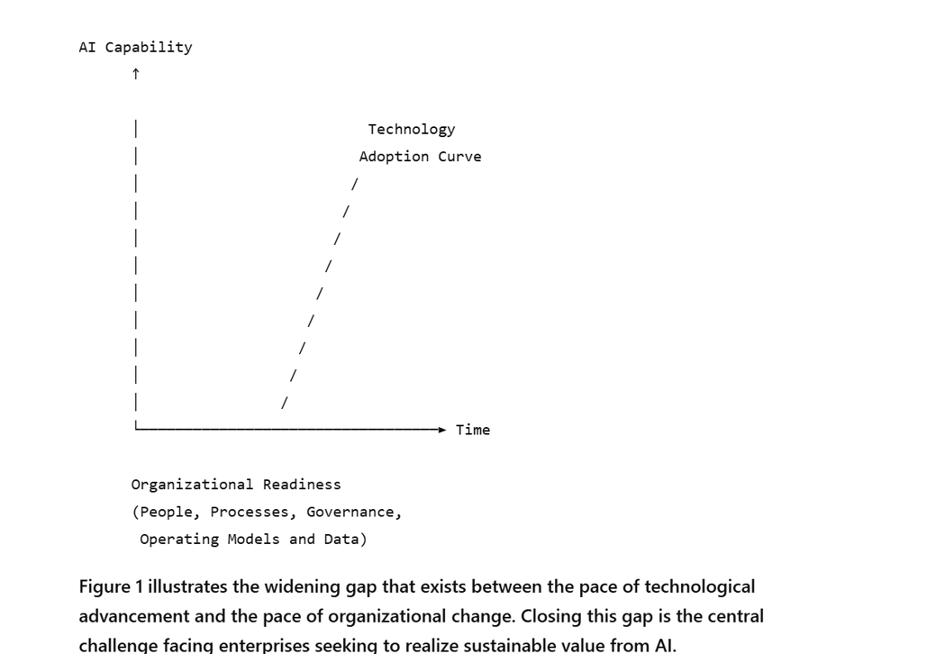
Figure 1. Technology Adoption Versus Organizational Readiness
AI Literacy: A Business Capability, Not a Technical Skill
Artificial Intelligence is often viewed through a technology lens.
Conversations tend to focus on models, platforms, copilots, and emerging capabilities. Yet while technology continues to evolve at an extraordinary pace, the success or failure of AI initiatives will ultimately depend less on the sophistication of the tools and more on the readiness of the people and organizations using them.
AI Literacy is not a technology issue.
It is a business capability.
At its core, AI Literacy is the ability of individuals and organizations to understand, evaluate, govern, and effectively utilize artificial intelligence to achieve desired business outcomes.
AI Literacy extends far beyond knowing how to use AI tools. It encompasses understanding what AI can and cannot do, recognizing when human judgment must prevail, appreciating the importance of trusted data, and ensuring that intelligent systems are deployed responsibly and ethically.
Most importantly, AI Literacy is not about turning every employee into a data scientist.
It is about creating a workforce capable of working effectively alongside intelligent systems.
Just as digital literacy became essential during the digital transformation era, AI Literacy is emerging as the foundational capability required to participate in the intelligent economy.
AI Literacy Is Everyone's Responsibility
The impact of AI extends beyond technology organizations.
Executives must understand strategic implications and governance requirements.
Managers must understand how AI changes workflows, roles, and performance expectations.
Practitioners must learn how to collaborate effectively with intelligent systems.
Risk, legal, compliance, and human resources teams must understand the implications AI introduces across the enterprise.
AI Literacy is therefore not a technical training initiative.
It is an enterprise-wide capability.
Organizations that treat AI Literacy as a narrow technology program will struggle to achieve scale. Organizations that embed AI Literacy across the enterprise will create cultures capable of adapting continuously as AI technologies evolve.
The Five Dimensions of AI Literacy
Successful AI adoption requires capability across five interconnected dimensions.
Workforce Literacy
Employees must understand how to use AI effectively within their roles.
This includes understanding prompting techniques, validation methods, responsible usage, and the importance of maintaining human oversight.
The objective is not simply greater efficiency.
The objective is augmenting human capability.
Data Literacy
AI systems are only as trustworthy as the data that supports them.
Employees must understand how data quality, context, lineage, accessibility, and governance influence AI outcomes.
Without trusted data, intelligent systems cannot be trusted.
Data literacy and AI literacy are inseparable.
Decision Literacy
AI increasingly influences business decisions.
Leaders and practitioners must understand how to interpret recommendations, evaluate confidence levels, recognize limitations, and maintain accountability for outcomes.
AI can enhance decision-making.
It cannot replace responsibility.
Governance Literacy
Responsible AI requires informed governance.
Organizations must understand ethical considerations, regulatory requirements, cybersecurity risks, privacy concerns, and compliance obligations associated with intelligent systems.
Governance is not a control mechanism designed to slow innovation.
It is the foundation of trust that enables innovation to scale.
Operating Model Literacy
Perhaps the least discussed dimension of AI Literacy is understanding how AI changes the nature of work itself.
Organizations must rethink workflows, accountability structures, decision rights, performance measures, and collaboration models.
Employees and leaders alike must understand not only how to use AI, but how AI reshapes the processes through which value is created.
Technology changes capabilities.
Operating models determine whether those capabilities become business outcomes.
Beyond Technical Training
Many organizations approach AI Literacy through tool-specific training.
Employees are taught how to interact with copilots or leverage generative AI platforms.
While useful, this approach addresses only a small part of the challenge.
True AI Literacy requires:
- Understanding AI strengths and limitations.
- Developing human-AI collaboration skills.
- Improving data awareness and stewardship.
- Embedding governance and accountability.
- Adapting operating models and workflows.
- Creating cultures of continuous learning.
Organizations that focus solely on tools risk creating AI users.
Organizations that focus on literacy create AI-enabled enterprises.
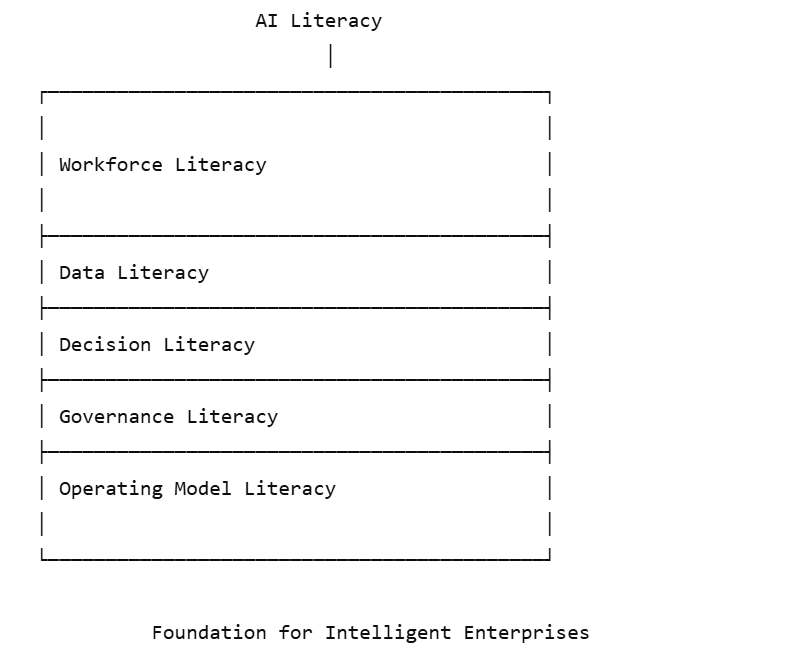
Figure 2. The Five Dimensions of AI Literacy
The five dimensions are mutually reinforcing.
- Workforce literacy enables adoption.
- Data literacy creates trust.
- Decision literacy improves outcomes.
- Governance literacy enables responsible innovation.
- Operating model literacy ensures that AI capabilities become sustainable business value.
Together, they form the foundation upon which intelligent enterprises are built.
Building AI-Ready Enterprises
AI Literacy prepares people for the future.
AI-ready operating models prepare organizations for the future.
While workforce readiness is essential, literacy alone is insufficient. Organizations may possess AI-capable employees and still struggle to realize value if their processes, governance structures, decision rights, and performance models remain rooted in pre-AI ways of working.
Technology does not transform organizations.
Operating models do.
AI-ready enterprises recognize that intelligent systems are not simply another technology layer. They represent a fundamental shift in how work is performed, decisions are made, and value is created.
Organizations that successfully scale AI rethink not only what technologies they deploy, but how humans and intelligent systems collaborate to achieve outcomes.
Understanding Enterprise AI Maturity
Most organizations currently reside somewhere along a continuum of AI maturity. While investment in AI technologies continues to accelerate, relatively few enterprises have achieved enterprise-wide transformation.
AI Curiosity
At this stage, employees experiment independently with AI tools.
Usage is informal, often ungoverned, and largely driven by personal initiative. The organization views AI with interest but lacks a formal strategy.
AI Exploration
Departments begin launching pilots and proofs of concept.
Technology teams evaluate use cases while business functions explore opportunities for productivity and automation. Capabilities remain fragmented and isolated.
AI Adoption
AI begins entering operational workflows.
Training programs emerge. Governance structures start to develop. Initial business value becomes visible. However, AI initiatives often remain localized and struggle to scale across the enterprise.
AI Operationalization
AI becomes integrated into business processes and decision-making frameworks.
Human and AI collaboration models become more structured. Governance, monitoring, and performance measurement mature. AI transitions from experimentation to operational capability.
AI-Native Enterprise
At the highest level of maturity, AI becomes embedded across people, processes, decision-making, and operating models.
Learning becomes continuous.
Human expertise and intelligent systems complement one another.
Governance is built into workflows.
Data is trusted and accessible.
AI is no longer viewed as a technology initiative.
It becomes part of how the organization creates value.
AI-Ready Operating Models
Many organizations attempt to deploy AI into processes designed for a pre-AI world.
This creates friction.
Traditional operating models were optimized around human effort and manual decision-making. AI-ready operating models are optimized around human and machine collaboration.
They address fundamental questions such as:
- Which decisions should remain human-led?
- Which decisions can be AI-assisted?
- Where can intelligent automation safely be introduced?
- How are AI-generated recommendations validated?
- Who remains accountable for outcomes?
- How are governance and compliance embedded into workflows?
- How should performance measures evolve in AI-enabled environments?
Organizations that fail to adapt their operating models often experience:
- Low adoption rates
- Shadow AI usage
- Limited trust in AI outputs
- Governance concerns
- Difficulty scaling successful pilots
Organizations that redesign their operating models experience:
- Faster value realization
- Greater productivity gains
- Higher workforce adoption
- Improved decision quality
- Increased organizational agility
- Stronger trust and governance
Technology creates possibilities.
Operating models determine whether those possibilities become business outcomes.
Human-AI Collaboration
One of the most important shifts facing organizations is learning how humans and intelligent systems work together.
AI excels at speed, scale, pattern recognition, and information synthesis.
Humans excel at judgment, creativity, empathy, ethics, and contextual understanding.
The future does not belong to humans or AI.
It belongs to organizations that learn how to combine the strengths of both.
Successful enterprises will increasingly organize work around augmentation rather than replacement.
Human expertise remains essential.
AI amplifies that expertise.
Together, they create new levels of productivity and decision quality.
Continuous Learning as a Strategic Capability
Unlike previous waves of digital transformation, AI capabilities evolve continuously.
The half-life of knowledge is shrinking.
Organizations can no longer treat learning as a periodic event.
Continuous learning must become part of the operating model itself.
AI-ready enterprises foster cultures characterized by:
- Curiosity and experimentation
- Responsible innovation
- Continuous re-skilling
- Cross-functional collaboration
- Data stewardship
- Shared accountability
- Adaptability and resilience
Learning organizations will outperform static organizations.
Not because they possess better technology.
But because they adapt faster.
The AI-Literate Enterprise
The AI-literate enterprise demonstrates several defining characteristics.
Its workforce understands how to collaborate with intelligent systems.
Its leaders understand both the opportunities and risks associated with AI.
Its operating models enable human-AI collaboration.
Its data is trusted, governed, and accessible.
Its governance frameworks are embedded into daily operations.
Its culture embraces continuous learning and adaptation.
Most importantly, AI is no longer viewed as a standalone technology initiative.
It becomes embedded in how the organization creates value.

Figure 3. Enterprise AI Maturity Model
Organizations do not become AI-native by deploying more technology. They become AI-native by developing AI-literate workforces, redesigning operating models, and embedding intelligent systems into the fabric of how work gets done.
Trusted Data Foundations: The Fuel Behind Intelligent Systems
Artificial Intelligence has captured the attention of organizations around the world.
Yet AI itself is not the source of competitive advantage.
Data is.
AI systems do not create knowledge in isolation. They rely on data to generate recommendations, automate processes, and support decision-making. Without trusted data, AI outputs become inconsistent, unreliable, and difficult to scale.
The promise of AI depends upon the quality, accessibility, governance, and context of the data that supports it.
Simply put:
Without trusted data, intelligent systems cannot be trusted.
Data Is No Longer a Technology Problem
Historically, data initiatives were viewed primarily as technology projects.
Organizations invested in data warehouses, master data management, integration platforms, and reporting environments. While these capabilities remain important, AI introduces a new requirement.
AI requires context.
Data alone provides facts.
Context provides meaning.
Intelligent systems must understand not only what happened, but why it matters, what actions are required, and which business rules, relationships, and dependencies influence outcomes.
Organizations that lack context often experience:
- Hallucinations and inaccurate outputs.
- Inconsistent recommendations.
- Limited trust in AI-generated decisions.
- Governance concerns.
- Difficulty scaling AI initiatives.
- Poor user adoption.
Data quality alone is no longer sufficient.
Organizations must establish trusted data foundations capable of supporting intelligent decision-making.
The Four Pillars of Trusted Data Foundations
Successful AI-enabled organizations typically demonstrate maturity across four interconnected areas.
Data Quality
AI systems inherit the strengths and weaknesses of the underlying data.
Incomplete, inconsistent, or inaccurate data leads directly to unreliable outcomes.
Data quality is not merely an IT responsibility.
It is a business capability.
Data Governance
As AI becomes embedded within critical business processes, governance becomes increasingly important.
Organizations must establish policies, ownership models, standards, and controls that ensure responsible use of information.
Governance creates trust.
Trust enables scale.
Data Accessibility
AI cannot generate value from data that remains isolated within silos.
Organizations require architectures that make trusted information accessible to people, applications, and intelligent systems while maintaining security and compliance.
Accessibility accelerates innovation.
Enterprise Context
Perhaps the most overlooked capability is context.
Context provides the business meaning that enables intelligent systems to understand relationships, dependencies, rules, and operational consequences.
Enterprise context bridges the gap between raw data and trusted decision-making.
It transforms information into intelligence.
Explainability and Trust
One of the greatest challenges organizations face is confidence in AI-generated outputs.
Employees and leaders naturally ask:
- Why did AI make this recommendation?
- What data influenced the result?
- Can the outcome be trusted?
- Who remains accountable?
Trust cannot be delegated to algorithms.
Trust must be engineered into the ecosystem.
Explainability, lineage, governance, and transparency become critical components of responsible AI.
Organizations that invest in trust will scale AI faster than organizations that focus solely on capability.
Data Literacy and AI Literacy Are Inseparable
Many organizations separate data literacy initiatives from AI literacy programs.
This separation creates unnecessary risk.
Employees cannot effectively evaluate AI outputs without understanding the quality, context, and limitations of the underlying data.
Likewise, AI systems cannot compensate for poor information management.
Data literacy and AI literacy must evolve together.
Organizations that invest in both capabilities develop workforces capable of:
- Asking better questions.
- Challenging assumptions.
- Understanding limitations.
- Making better decisions.
- Building trust in intelligent systems.
Data literacy creates confidence.
AI literacy creates capability.
Together, they create intelligent enterprises.
Trusted Data Foundations Enable Sustainable Business Value
The organizations that derive the greatest value from AI recognize a fundamental truth:
AI is not the foundation.
Data is.
Trusted data foundations provide the fuel that enables intelligent systems to operate effectively.
AI-literate workforces determine how those capabilities are applied.
AI-ready operating models determine how those capabilities are scaled.
Together, they create sustainable business value.
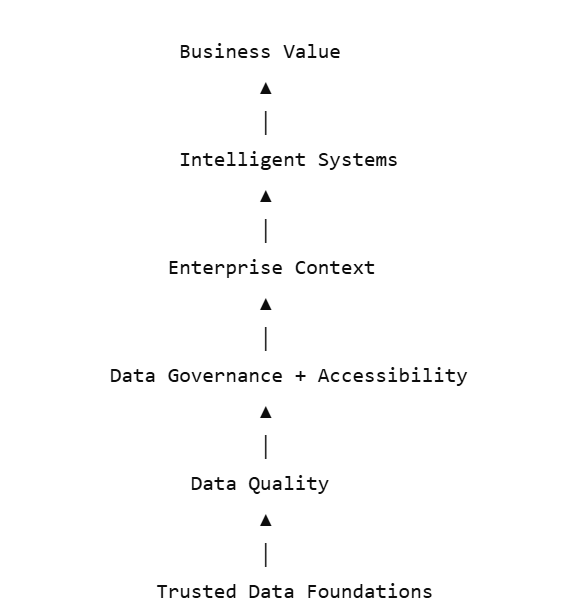
Figure 4. The Intelligent Enterprise Stack
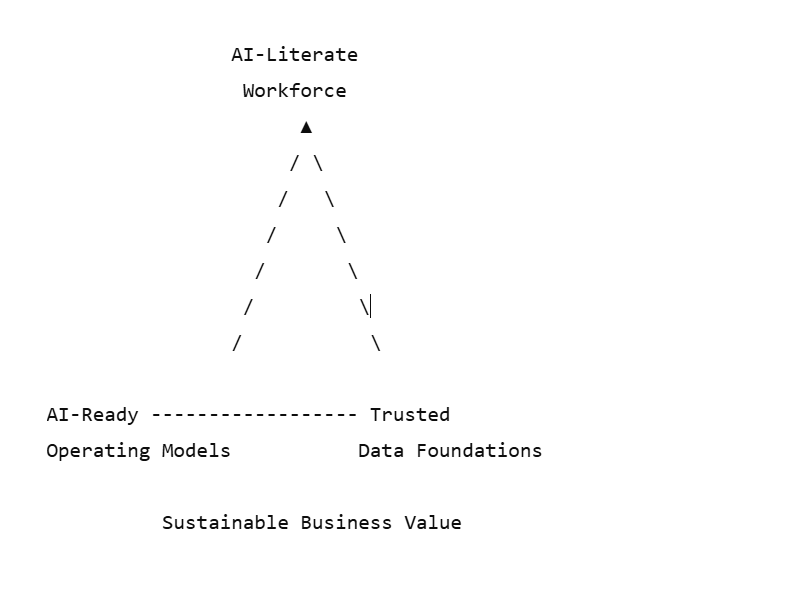
Figure 5. The Intelligent Enterprise Triangle
The intelligent enterprises of the future will not be defined by AI technology alone.
They will be defined by the combination of AI-literate workforces, AI-ready operating models, and trusted data foundations.
These three capabilities form the pillars upon which sustainable business value is built.
The AI Literacy Roadmap
Building AI-literate workforces, AI-ready operating models, and trusted data foundations does not happen overnight.
Nor does it require organizations to transform everything at once.
Successful organizations approach AI readiness as a journey rather than a destination.
They recognize that AI transformation is not simply a technology initiative.
It is an organizational capability that evolves over time.
The objective is not to deploy more AI.
The objective is to create an enterprise capable of continuously learning, adapting, and realizing value from intelligent systems.
Organizations seeking to improve AI readiness should focus on six priorities.
Assess Current Capability
Transformation begins with understanding the current state.
Many organizations invest heavily in AI technologies without understanding their existing levels of AI literacy, data maturity, governance capabilities, or operating model readiness.
Leaders should establish a baseline across:
- Workforce AI literacy.
- Leadership understanding.
- Data literacy and stewardship.
- Governance capabilities.
- Process maturity.
- Operating model readiness.
- Human-AI collaboration practices.
Understanding current capability allows organizations to prioritize investments and identify gaps before attempting large-scale transformation.
Maturity creates clarity.
Clarity creates focus.
Define Role-Based Expectations
Not everyone requires the same level of AI capability.
Executives, managers, practitioners, and specialists interact with AI differently.
Organizations should define role-based expectations across the enterprise.
Executives
Require strategic literacy.
They must understand opportunities, risks, governance requirements, and workforce implications.
Managers
Require operational literacy.
They must understand how AI affects processes, performance measures, decision-making, and team structures.
Practitioners
Require functional literacy.
They need skills related to prompting, validation, critical thinking, and responsible AI usage.
Specialists
Require technical literacy.
They must understand model development, architecture, governance frameworks, and implementation practices.
AI literacy is not one-size-fits-all.
Learning paths should reflect the responsibilities of each role.
Develop Enterprise Learning Programs
Many organizations approach AI education through isolated tool training.
This creates users.
Not capabilities.
Effective AI learning programs extend beyond platforms and prompts.
They include:
- AI fundamentals.
- Human-AI collaboration.
- Data literacy.
- Responsible AI principles.
- Governance and compliance.
- Critical thinking and validation.
- Decision-making frameworks.
- Continuous learning practices.
Organizations should foster cultures where learning becomes part of everyday work.
AI literacy is not a one-time event.
It is an ongoing capability.
Strengthen Trusted Data Foundations
Data literacy and AI literacy are inseparable.
Organizations must improve:
- Data quality.
- Governance.
- Accessibility.
- Context.
- Stewardship.
- Transparency.
Employees must understand how data influences outcomes and how poor information quality affects trust.
The organizations that derive the greatest value from AI recognize that intelligent systems cannot compensate for weak data foundations.
Trust begins with information.
Redesign Operating Models
Perhaps the most significant challenge organizations face is adapting operating models to AI-enabled ways of working.
Existing processes were designed for human effort.
Future processes will increasingly involve collaboration between humans and intelligent systems.
Organizations should evaluate:
- Decision rights.
- Accountability structures.
- Workflow design.
- Governance mechanisms.
- Human-AI interaction models.
- Performance measures.
- Risk management frameworks.
AI-ready operating models enable organizations to convert capability into business outcomes.
Technology creates possibilities.
Operating models create value.
Build a Culture of Continuous Learning
AI technologies evolve continuously.
Organizations that treat learning as an occasional event will struggle to keep pace.
Future-ready enterprises cultivate cultures characterized by:
- Curiosity.
- Experimentation.
- Adaptability.
- Responsible innovation.
- Collaboration.
- Knowledge sharing.
- Lifelong learning.
Learning itself becomes a strategic capability.
The organizations that learn fastest will adapt fastest.
And those that adapt fastest will create sustainable competitive advantage.
Transformation Is a Journey
AI transformation should not be viewed as a single project.
It is an ongoing process of capability development.
Organizations that succeed typically begin with focused initiatives, establish foundational capabilities, learn from experience, and expand incrementally.
Progress matters more than perfection.
The goal is not to become an AI-native enterprise overnight.
The goal is to build an organization capable of continuously evolving alongside intelligent systems.
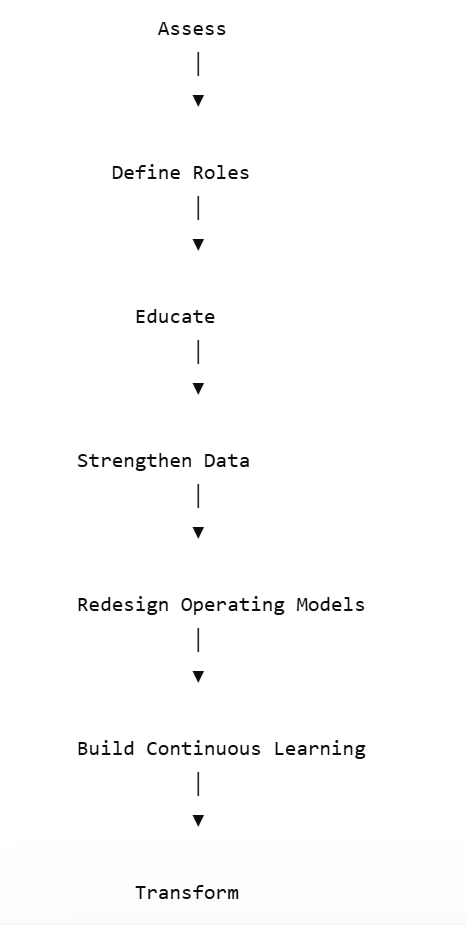
Figure 6. The AI Literacy Roadmap
Organizations that follow this progression create more than AI capabilities.
They create resilient, adaptive enterprises capable of realizing sustainable business value from intelligent systems.
Leadership in the Age of AI
Throughout history, transformative technologies have reshaped industries, redefined business models, and altered the nature of work.
Artificial Intelligence is no different.
What makes AI unique, however, is the speed at which change is occurring and the breadth of its impact across every function of the enterprise.
As a result, leadership itself must evolve.
One of the greatest risks facing organizations is not workforce illiteracy.
It is leadership illiteracy.
Executives do not need to become AI engineers.
But they do need to understand how AI changes business.
The organizations that lead the next decade will not necessarily be those with the most sophisticated technology.
They will be those guided by leaders who understand how to combine intelligent systems, human expertise, and trusted information to create sustainable value.
AI Leadership Is Different from Technology Leadership
Historically, technology decisions could be delegated to IT organizations.
AI changes this model.
AI influences strategy.
It affects operating models.
It changes workforce requirements.
It introduces new risks.
It raises ethical questions.
It impacts customers, employees, regulators, and shareholders.
AI is not simply a technology issue.
It is a business issue.
And business issues require leadership.
Leaders who view AI solely through a technology lens risk underestimating its implications.
Leaders who understand AI as a strategic capability will shape the future of their organizations.
The New Responsibilities of Leadership
Leadership in the age of AI requires balancing innovation with responsibility.
Executives must address several critical questions:
- Where can AI create competitive advantage?
- Which decisions should remain human-led?
- How will AI affect the workforce?
- How should governance evolve?
- What risks must be managed?
- How should performance measures change?
- What investments should be prioritized?
These questions cannot be delegated.
They require informed leadership.
Technology teams may implement AI.
Leaders determine how AI creates value.
Leadership Literacy
Executives do not need technical depth.
They do require literacy.
Leadership literacy includes understanding:
Strategic Implications
How AI changes markets, business models, products, and competitive dynamics.
Workforce Implications
How intelligent systems reshape jobs, skills, and organizational structures.
Governance Responsibilities
How to establish trust, accountability, transparency, and responsible AI practices.
Risk Management
How to address regulatory, ethical, cybersecurity, privacy, and operational risks.
Investment Priorities
How to balance investments across technology, people, operating models, and data foundations.
Leadership literacy creates clarity.
Clarity enables confidence.
Confidence accelerates transformation.
Culture Begins at the Top
Technology adoption is rarely constrained by technology.
More often, it is constrained by culture.
Leaders shape culture through priorities, behaviors, and incentives.
Organizations that successfully scale AI typically foster cultures characterized by:
- Curiosity.
- Continuous learning.
- Responsible innovation.
- Experimentation.
- Collaboration.
- Accountability.
- Trust.
Employees observe leadership behavior.
If leaders embrace learning, others follow.
If leaders encourage experimentation, innovation flourishes.
If leaders emphasize governance and responsibility, trust emerges.
Culture is not an abstract concept.
It is leadership made visible.
Human Leadership in an Intelligent World
As AI capabilities expand, human leadership becomes even more important.
Machines excel at speed, scale, and pattern recognition.
Humans provide judgment, empathy, ethics, creativity, and purpose.
AI may enhance decisions.
It cannot replace leadership.
The future will not belong to organizations led by algorithms.
It will belong to organizations led by humans who understand how to leverage intelligent systems responsibly and effectively.
Human leadership remains the ultimate competitive advantage.
Leading Through Uncertainty
No leader possesses all the answers regarding AI.
The technology continues to evolve.
Business models will change.
New risks will emerge.
Workforces will adapt.
The organizations that thrive will not necessarily be those that predict the future most accurately.
They will be those that learn and adapt most effectively.
Leaders must become comfortable with uncertainty.
They must cultivate organizations capable of continuous learning rather than fixed planning.
Adaptability becomes more important than certainty.
Learning becomes more important than knowing.
Leadership Is the Multiplier
Technology amplifies capability.
Leadership amplifies organizations.
AI-literate leaders create AI-literate cultures.
AI-ready leaders create AI-ready operating models.
Leaders who prioritize trusted data create trust throughout the enterprise.
Leadership is the multiplier that connects people, operating models, and data foundations.
Without leadership, AI initiatives remain experiments.
With leadership, AI becomes transformation.
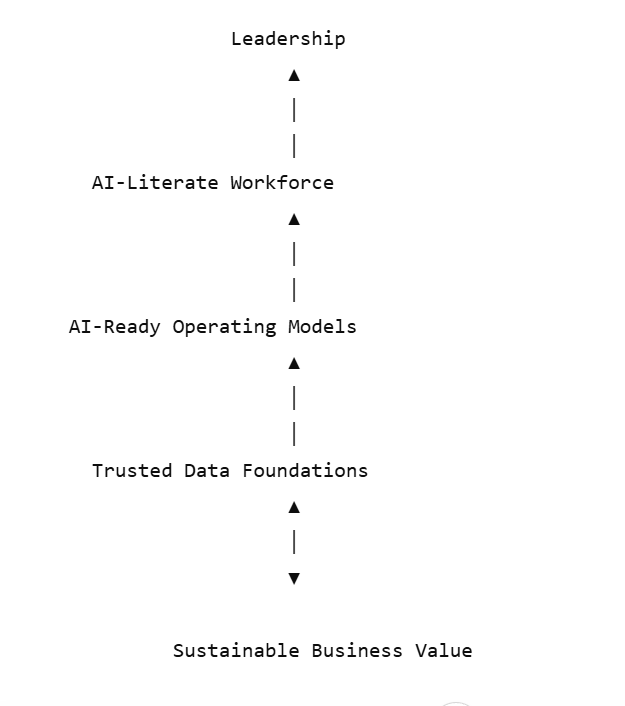
Figure 7. Leadership as the Multiplier
The organizations that define the next decade will not be distinguished solely by their access to AI.
They will be distinguished by the quality of their leadership.
Leadership, more than technology, will determine who adapts, who innovates, and who creates lasting competitive advantage.
From AI Experimentation to AI Transformation
Artificial Intelligence has moved beyond the stage of curiosity.
Across industries, organizations are investing heavily in platforms, copilots, intelligent automation, and emerging agentic capabilities. Yet despite unprecedented levels of investment, many enterprises continue to struggle to realize sustainable business value from AI.
The challenge is not access to technology.
The challenge is transformation.
Most organizations are still focused on experimentation.
Pilots continue to proliferate. Use cases expand. New tools emerge almost daily. Yet isolated successes do not necessarily translate into enterprise value.
Transformation requires more than technology investment.
It requires organizational capability.
The organizations that successfully transition from experimentation to transformation recognize that AI is not a project.
It is an operating model.
They understand that intelligent systems must become integrated into the fabric of how work is performed, decisions are made, and value is created.
The Four Capabilities Required for AI Transformation
Organizations seeking to realize sustainable value from AI must develop four interconnected capabilities.
AI-Literate Workforces
People remain at the center of transformation.
Employees must understand how to collaborate with intelligent systems, validate outputs, exercise judgment, and apply AI responsibly.
AI literacy enables individuals to work effectively alongside intelligent systems.
AI-Ready Operating Models
Processes, workflows, governance structures, and accountability mechanisms must evolve to support AI-enabled ways of working.
Technology creates possibilities.
Operating models create value.
Organizations that fail to redesign operating models will struggle to scale successful pilots.
Trusted Data Foundations
Data remains the fuel behind intelligent systems.
Without trusted, governed, accessible, and contextualized data, AI outputs cannot be trusted.
Data quality, governance, accessibility, and enterprise context provide the foundation upon which intelligent enterprises are built.
Leadership
Transformation ultimately depends on leadership.
Leaders shape culture.
They establish priorities.
They determine investments.
They balance innovation with responsibility.
Most importantly, they create organizations capable of continuous learning and adaptation.
Leadership is the multiplier that converts capability into business outcomes.
Human and Artificial Intelligence Are Complementary
Much of the discussion surrounding AI focuses on replacement.
The more important opportunity is augmentation.
AI excels at speed, scale, and pattern recognition.
Humans excel at judgment, empathy, creativity, ethics, and contextual understanding.
The future does not belong to humans or machines.
It belongs to organizations that learn how to combine the strengths of both.
Human expertise amplified by intelligent systems represents a new model for creating value.
Organizations that embrace augmentation rather than replacement will realize greater trust, higher adoption, and stronger outcomes.
Learning Becomes the Ultimate Competitive Advantage
Throughout history, competitive advantage has been created through scale, capital, technology, and access to information.
AI changes this equation.
Technology is increasingly accessible.
Information is increasingly abundant.
The true differentiator becomes the ability to learn and adapt faster than competitors.
Organizations capable of continuously developing their people, evolving their operating models, and strengthening their data foundations will outperform organizations that treat transformation as a one-time initiative.
Learning itself becomes a strategic capability.
The organizations that learn fastest will adapt fastest.
And the organizations that adapt fastest will create lasting competitive advantage.
The Intelligent Enterprise
The intelligent enterprises of the future will share common characteristics.
They will possess:
- AI-literate workforces.
- AI-ready operating models.
- Trusted data foundations.
- Responsible governance frameworks.
- Continuous learning cultures.
- Human-AI collaboration models.
- Leaders who understand both opportunity and risk.
Most importantly, AI will no longer be viewed as a standalone technology initiative.
It will become embedded into the way organizations create value.
The question facing leaders is no longer whether AI will change their organizations.
The question is whether their organizations are prepared to change alongside AI.

Figure 8. The Intelligent Enterprise Framework
Conclusion
AI Literacy Is the New Digital Literacy
Twenty years ago, digital literacy became essential for participating in the modern economy.
Today, AI Literacy is emerging as the next foundational business capability.
But AI Literacy alone is not enough.
Organizations must also develop AI-ready operating models and trusted data foundations capable of integrating intelligent systems into the fabric of how work is performed, decisions are made, and value is created.
The future will not be defined by who has access to AI.
The future will be defined by who learns fastest, adapts continuously, and understands how to combine human expertise with intelligent systems.
AI Literacy is no longer a workforce initiative.
AI-ready operating models are no longer an operational initiative.
Trusted data foundations are no longer simply a technology concern.
Together, they represent a business strategy.
And they may become the defining competitive advantage of the next decade.
About the Author
Ernest D. Martinez Jr. is a technology executive and advisor with more than two decades of experience helping organizations transform through data, analytics, artificial intelligence, and modern operating models. His work focuses on connecting trusted data foundations, AI-enabled business capabilities, and organizational readiness to create sustainable business value.
Create an account to continue reading
Create a free Connect account or sign in to read the full article and access member-only insights.